Friday, January 27, 2012

The Diviners et al.

Before I moved to Toronto in 2005, I had a yard sale. Not only did it provide me with some well needed extra cash in my pocket, it also helped me cull some possessions I no longer needed or wanted. At that time, I also culled some books in my possession. I recall at that time though, looking at the bookcase that held all of my Acadia books and thought “No, I am not ready to part with these quite yet.”

A bookcase in my parent’s living room has held all of my novels and textbooks from my undergraduate degree. Some were purchased during my exchange year in Scotland, but most were obtained via my studies at Acadia University. As I did a double major in English and History (minor in Political Science and Art History), the majority of books were paperback novels and history, poly sci, and art history textbooks...and I treasured them all.


I took a variety of English classes at Acadia – 16th century literature, Victorian literature, Women’s literature and in my second year, I was introduced to Canadian literature. I will have to say that prior to this class Canadian literature was completely foreign to me. Unlike students in most other Canadian provinces, I had not read Margaret Atwood in high school. I will be honest and say I hadn’t even heard of her before going to Acadia. I sincerely hoped this has changed in PEI schools. Come to think of it, I remember looking at one of my grade ten English books that consisted of short stories written by contemporary American writers and thinking “Why are we reading this?” Anyway, I digress...

My classes of Canadian literature taken at Acadia opened up a wonderful new world to me – especially the third year class I took with Professor Jack Sheriff. We had to read one novel a week and took turns presenting – each time focused on the four elements of theme, character, style, and structure. One by one, we dissected novel after novel. I spent every waking moment reading that semester, but I loved every minute of it. I read Ernest Buckler’s Mountain and the Valley, in the ‘valley’ that it was written. Percy Janes’ House of Hate left a lasting impression on me. I was introduced to Margaret Atwood through The Edible Woman, a book that still puzzles me. And then I was introduced to the ‘other’ Margaret.


The Diviners was my introduction to Margaret Laurence and it was a book I would come to love for so many different reasons. I loved all the different themes that ran through the book – most of all the awakening that comes in one’s connection and /or discovery of family history. The Stone Angel was next and with it and many of her other books, Laurence’s female perspective on contemporary life drew me in. The Prophet’s Camel Bell and Heart of a Stranger were also engaging reads, but it was Laurence’s autobiography Dance of the Earth: a Memoir that is still one of my all time favourite books.

In the many years since my studies at Acadia, I have continually turned to Canadian Literature. I have come to love the work of Farley Mowat, Timothy Findley, Mordecai Richler, Ann-Marie MacDonald, and Robert Sedlack to name a few. I am so grateful for that class I took with Professor Sheriff so many years ago. He taught us how to dissect a novel and it changed the way I read books.

As connected as I was to these novels, I decided it was time to let them go. The older I get the less attached I am to material possessions. These books gave me so much and I will always have that – with or without their physical presence. While I was home at Christmas, I decided one of my projects was to go though all my books. I went through my three book cases and I will have to say that my archival appraisal skills came in very handy. Before I knew it I had four banker boxes full. The following day, I donated all four boxes to my local library. Hopefully somebody else will enjoy reading these Canadian classics and happen upon an author they will come to love.


Completely cleaning out the small bookcase in the living room also gives my Mother more room to house her own growing collection of books. My Dad doesn’t tend to read novels per say and tends to stick to the daily newspaper and monthly Ayrshire Review. But one book of Dad’s holds a special and amusing place on the bookcase. A few years ago, we cleaned out the attic at Auntie’s house. Going through boxes of books, I happened to come across the book below. Awarded to Dad when he attended St. Peters Bay North School, this book was a gem to find – even if he has no memory of receiving it. So it is an old, but recent addition to the new holdings in the Rossiter house. Out with the old and in with the new – to us.


Friday, January 13, 2012

My Family Cookbook


All the women in my family are/were fantastic cooks. Auntie and Grammie were both known for their abilities in the kitchen. Everything they made tasted delicious and was made to perfection after years of perfecting every recipe. My Mother has also followed suit – capable of whipping up a meal for ten with no fear and a pan of biscuits at a moment’s notice. Like Auntie and Grammie, she has all kinds of “tricks of the trade.” She knows what textures should look and feel like and how to manipulate recipes to work in her favour. The older I get, I am increasingly aware that I still have so much to learn with respect to cooking and baking. So every chance I get, I bake and cook with Mom and I pay a little more attention with the hope that something will *stick*.

For Christmas 2007, I asked Hilda for a different kind of Christmas present. I asked her if she would write out all of her and Auntie’s recipes in a book for me and she happily complied. Dated December 2007, Hilda inscribed the book:

Dear Juanita,
These recipes were copied with love from old and not so old books that Auntie used over her years of baking. I hope you will keep it going with recipes of your own now and pass it along.
- Auntie Hoolie

This little black binder contains recipes, but what I am also grateful for is that Auntie Hoolie noted the provenance of each recipe and little antidotes where the recipe warranted it. In addition to Auntie and Hilda, there are also recipes from my cousins, Great-Aunts, and Aunts from the paternal side of my family including Toddy Ryan, Aunt Babe, Margaret Ben, Margaret Reggie, Little Joe (Lewis), Aletha, Loretta Lewis, and Marion McIsaac. I then had my Mom add to the book, including her and Grammie’s recipes.

Just re-reading Hoolie’s inscription in the book, I realize I now have to add some of my own recipes to the book. I don’t have a lot of things I make from scratch, but my chicken lasagne comes to mind....and I haven’t made it lately!

After a successful production of Auntie’s meat pies, my Mom and I then decided to try our hand at a Sultana Cake. After my Mom’s cherry cake, it is my favourite of the Christmas season. And like our meat pie production, I decided to provide a visual of this production.


When Mom looked at me (above) beating the wet mixture she chucked and said “Look at your little hands beating away.” This was in reference to a story brought up over the holidays that I had never heard before. While visiting my Aunt and Uncle in Brudenell, somehow the subject of “hands” came up. My Mom shared a story about when her and Dad were on one of their first dates. They of course held hands, only to have my father blurt out to my Mother, “My God you have big hands!” My mother, who inherited her Mother’s large working hands was of course horrified – and forty five years later, is still indignant about the comment. I thought the story – and my mother’s delivery of it – was priceless.


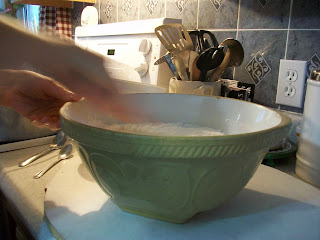
Once again, we incorporated both Auntie and Grammie into the experience. We used Grammie’s mixing bowl and Auntie’s cake pan (and recipe). And here is my Mom (with her big hands!) holding the cake just before we popped it into the oven.


The cake took 2.5 hours to cook, which seemed like forever. And because it is something we only make once a year, we were a little more observant than usual. We spent the majority of that waiting time in the kitchen. I worked on a craft project and Mom kept me company. At one point, Mom felt the cake was rising a little too much so she started talking to it with the hope that it would listen. Above, she pointed to the cake and told it to “STOP” as it still had 45 minutes to cook. Thankfully, it listened.


The cake turned out to be very level, which Mom said it sometimes difficult to achieve. She then gave me some hints as to how to get the cake out of the funnel pan. And flop, before we knew it, it was out.


I treasure these recipes – especially because they are written out by Auntie Hoolie and Mom. I treasure the well seasoned mixing bowl and cake pans once used by Grammie and Auntie. And I of course treasure the time and experience of baking with my Mom...and the laughs we have in the process.

Sunday, January 08, 2012

Meat Pie Anyone?

Every family has its Christmas traditions. Growing up, a typical Christmas Eve for our family began by attending Midnight Mass at St. Peter’s Bay RC Church. I recall singing in the choir with my friends and cousins, all of us struggling to get through the “G-l-o-r-i-a” stanza of “Angels We Have Heard on High” because (A) We were all so tired and (B) None of us knew how to get through the long stanzas properly. The church was always full as many families from nearby communities “came home” to the church they had grown up in for the Christmas celebration.

After Midnight mass, we all gathered next door to ring in Christmas Day with Auntie, Harold, Joe and Hilda. Sometimes it was just our immediate family and sometimes we were joined by cousins and neighbours. One thing that remained constant was Auntie’s meat pies. We all looked forward to this treat as this was the only time of the year she made them. Meat pies were therefore one part of the Christmas equation in our family.

Auntie’s meat pie recipe written out by Hilda.


Auntie and Hilda generally spent all day Christmas Eve making the pies. I was never involved in this baking and therefore didn’t pick up any of Auntie’s baking tricks of the trade. After Auntie’s death in 2003 this family tradition of having meat pie Christmas Eve lapsed for a few years. Circa 2008, my Mother expressed interest in possibly reviving the tradition. I recall my Father’s excitement; mainly because I had no idea he missed it so much. My Mother said she also loved the tradition (and the pies) so we decided to give it a go.

We dug up Auntie’s recipe and Mom talked with her nursing co-workers about their plan of attack with respect these pies – as many people make them. We were a little nervous about living up to Auntie’s high standard of cooking, but we decided to give it a shot. We made six or eight pies that first year and we were relieved to discover they were completely edible! One batch under our belts gave us the confidence we needed and we’ve done it every year since. Each year it seems to get easier and more familiar.

We’ve increased our productivity each year and this year produced fifteen pies - our largest number yet! We’ve made the process a little easier by involving the use of a food processor that greatly reduces the manual work involved (cutting all the meat!). In our pies, we use a combination of roast beef, pork and chicken, and we use Bertha MacAulay’s pastry recipe. Here’s a visual to this year’s Rossiter production line of meat pies:


The Pastry Master!

I still find the pastry difficult so Mom generally does this component of the process. Although she would never admit it, she’s a master of most items in the pastry field (her biscuits are second to none!). We also included Grammie in our annual tradition by using her bowl.


I somehow managed to forget to take a photo of the fifteen pies upon completion. But here is a shot of ten shells and four pies ready to go in the oven.


This year, I also decided to channel my inner Auntie by donning an apron, which I believe would have made her smile. You *never* saw Auntie without an apron. She wore one everyday (many of which she made herself) and she always had a clean one on hand in case unexpected company dropped by.


Although I forget to get a photo of the final fifteen, here is a close up of a completed pie to wet your appetite. I have two pies in my freezer here in TO and look forward to nibbling away at them well into the New Year.


And doing this with my Mother means of course we have a lot of laughs along the way. Some of the more memorable Mama Rossiter quotes from this year’s maratheon:

In reviewing the recipe prior to beginning my Mother said out loud “Bake at 400 degrees? That sounds kind of ferocious!”

Finishing the last pie she looked into the empty pastry bowl and said “I didn't think I would ever see it again (an empty bowl).”

After learning that her daughter-in-law Karen uses the left over juice that the meat was cooked in for gravy, Mom meant to say “And all the years I threw it out,” but instead said “And all the years I threw it up.”

I am already looking forward to doing it again next year.

Saturday, December 17, 2011

The White Kitten


Most weekends I talk to my Dad on the phone. The older he gets the more time he spends reminiscing about the past. This past weekend he re-told a story I’ve heard before but hearing it this time somehow caught my attention on another level. As he re-told the story, I could hear the excitement re-lived by his childhood self. It was touching to hear the impact one particular Christmas present had on him over sixty years ago.

By the time my Father was six years old he and his three siblings had left their childhood home in Morell and were being raised by their Aunt Hilda (Auntie) and Uncle Harold in Greenwich. His father had died when he was ten months old only to be followed by the tragic death of his mother six years later. To say this young family had a rough start would be an understatement, but they were fortunate in that Harold and Auntie kept the children together and raised them in a loving, structured home.

Christmas of 1944 was his first Christmas in Greenwich. My father, two months shy of his seventh birthday, remembers that winter well. One pastime the children had was watching their next door neighbour Walter Hayden from the east window in the kitchen. Everyday Mr. Hayden would walk to the back woods to see if he had caught anything in his traps and Dad said they would always watch him as he made his way back to his farm to see if he caught anything. Dad recalls that he was barely tall enough to see over the window ledge.

On Christmas day, 1944, Dad recalled that everyone sat in for dinner at the kitchen table and before long there was a knock at the door. Harold got up to answer the door and he heard Mr. Hayden at the door say “Is Bob there?” Dad said he nervously got up and went to door. When he got there Mr. Hayden reached into an inside pocket in his long black coat, pulled out a little white kitten, and said “Merry Christmas Bob.”

Dad recalled the excitement both he and his siblings expressed and remembered how difficult it was to then sit down to Christmas dinner. Ever since that Christmas, we have always had white cats on our farm – and if we don’t, Dad is in search of them. As I said, I’ve heard this story many times. But hearing it again recently I put it into context and saw, and felt it in a whole new light. I suddenly realized the impact that that the gift of this little white kitten would have on a child who at only six years of age had recently experienced such great tragedy in his life. I never knew Mr. Hayden but, but am touched by his gentle gesture. It is another reminder for me at this time of the year as to the true meaning of Christmas.


The Hayden Farm

Saturday, November 05, 2011

A glimpse of Ireland

A few collages of my trip to Ireland.


Many times man lives and dies
Between his two eternities,
That of race and that of soul,
And ancient Ireland knew it all.
Whether man die in his bed
Or the rifle knocks him dead,
A brief parting from those dear
Is the worst man has to fear.
Though grave-diggers' toil is long,
Sharp their spades, their muscles strong.
They but thrust their buried men
Back in the human mind again.

- William Butler Yeats
"Under Ben Bulben"

Saturday, September 17, 2011

Josie


It has been fourteen years since she died. I was in Japan when I got the call from Dad. That night I went to bed and dreamed about her. She was young, healthy, smiling, tanned and looked so beautiful. She looked so happy. The next morning I awoke and was shaken – the dream about her was so real. Maybe Dad’s telephone call had been the dream instead? I decided to call my Aunt Hilda that morning and as soon as I heard her voice I knew it had been real. Josie was gone.

Josie was the second youngest of five siblings in my Mother’s family. According to family reports Josie was spoiled from the get go. In her father’s eyes she could do no wrong, which of course sometimes frustrated the other children, including my Mom. While the older siblings were in school, Josie would get into their “stuff.” All the precious little items that at the time meant so much to them, such as make up samples betrothed onto them by their mother. Coming home to find Josie “made-up” with their makeup smeared all over her face resulted in an immediate kerfuffle. In later years Josie said to my Mother “I remember thinking that you hated me” and without skipping a beat my Mother replied “Because I often did” after which they broke into peels of laughter.

There are many others who know so many more of the details of Josie’s life than I. Time and time again, I’ve heard how incredibly popular Josie was and that always had “a million” friends. She was a beauty queen having been crowned “Queen of the Sea” while in high school, and she always had a boyfriend. She had it all. My childhood memories of Josie include images of many weekends she came to spend with us at the farm. My mother always looked forward to these visits. They would sit at the kitchen table and talk and smoke their brains out well into the night. It was the only time my Mother smoked, which I still find strange, but I believe they had a hell of a time. Looking back now, I realize that Mom and Josie were the most alike in their dispositions. They were both very secure in themselves, loved to laugh, have fun and enjoy life. They were both so real – nothing phoney at all – and that was what attracted people to them.


All of us in bed with Josie...when we were not supposed to be!

Josie married Jimbo, and we all thought the world of him. I remember bits and pieces of her wedding day. I remember Mom’s pink bridesmaid dress (which was later cut to a knee length dress that our cousin Maura wore to a prom dance) and how sweet Erica looked as her flower girl. I was in charge of throwing the confetti outside the church and was reminded on more than one occasion by Josie how I threw it in one big lump onto her head when she exited the church. All I remember is being nervous and letting it go, which in retrospect proved to be an early example of how I do not work well under pressure.

Josie and Jim bought a home on Queen Elizabeth Drive in Charlottetown and it was a home I would come to know well. After graduation, I moved into ‘town’ at ca. seventeen years of age and where I spent the subsequent two years. At that time, I shared a two bedroom apartment with three other girls and yes, it was hell. So during those two years, it wouldn’t be a stretch to say I spent the majority of my time at Josie’s house when I wasn’t at school or working. I had started my undergraduate studies at the local University and I worked at Cows on evenings and weekends. I often had to work late shifts and instead of taking a cab home, Josie often offered to come and get me. I can still see her waiting in the car for me on Queen’s Street. We’d go back to her place and would sit up watching late night TV, and I always stayed for the night. We had so many great chats and of course a lot of laughs. She was so easy to be with and she made me feel so loved. I am so grateful for those memories and for that time in my life.

At a very young age Josie was diagnosed with Chron’s Disease and it was a bad case from the outset. She had countless surgeries numerous periods of remission. When Josie was well, the world was hers. But when she was sick, she was naturally like a different person. The large doses of prednisone she took over the years resulted in her bones becoming very brittle very quickly. A number of effects and side effects from Chron’s Disease ultimately took their toll and Josie died in September of 1997. She left us much sooner than she should have, but we knew she was in a much better place. Her final days in this world were incredibly difficult and painful for her.

This time every September, I inevitably think of Josie. I think of her beautiful brown sparkling eyes and her laughter. I think of her manicured nails that often held a cigarette in place. I think of her and my mother sitting at our kitchen table in Greenwich talking and laughing. I think of all the good times and positive things, and am not sad because I truly believe she is in a better place. And I know she is still talking, laughing and making friends easily.

Friday, September 02, 2011

Dark Side of the Sun

I’ve always loved history. Looking back, I now realize I’ve always had a preference for social history. I avoided military history at all costs in University and remember being annoyed at the ‘guns and boats’ history students (mostly boys) who felt nothing else mattered in the grand scheme of things.

My grandfather Eugene Francis Rossiter served in WWI. It wasn’t until his war medals surfaced ca. ten years ago did I experience my first flicker of interest in military history. Once it became a personal story I could relate to, I saw military history in a completely different light. I placed an order for his Attestation Papers from Library and Archives Canada (that are now available online) and it provided me with more information than I had ever previously known about him.


His regimental number was 713255 and he enlisted on May 30th, 1916, when he was nineteen years old. My Grandfather served in the 105th Battalion along with many other Island men during WWI and he saw battle in France. Because my grandfather died when my father was only ten months old, we know very little about him. I was therefore grateful for every little piece of information gleaned from these papers – including the fact that like me he had “grey” eyes.


For Christmas, my brother Peter gave me the book Dark Side of the Sun by Michael Palmer. The book is about the author’s grandfather George Palmer and the Canadian Prisoners of War (POWs) in Hong Kong, and subsequently in the Omine Camp in Kyushu, Japan. It just so happens that George Palmer is from my hometown, St. Peters Bay. So again, this is story concerning military history is one that I had a connection to.

I babysat for George’s son Norbert and his daughter Joan – seven of his grandchildren in total. And a lot of those evenings where spent in his old home – the Palmer homestead in Cable Head. Before George passed away in 1991, my Mother (a nurse) did private duty with him in Souris hospital. I remember babysitting for Norbert and Mary the weekend of George’s wake and funeral. As I read this book I thought of all these connections but realized I knew nothing of George himself.

I had always heard that George would seldom talk of his war time experiences. I knew that he had been a POW in Japan and that was about it. I remember telling his daughter Joan that I was going to Japan to teach English. She responded be counting to ten in Japanese. I asked her how she knew to do that and she said her father George had taught her (he had learned from the Japanese guards who counted the POWS several times daily). It was these accounts and memories of George’s children that Michael Palmer relied on and incorporated into the book to trace George’s military service during WWII. With his children’s memories, personal letters written by George during the war and a myriad of primary and secondary sources, Michael weaved together his grandfather’s story and it was a fascinating read.

I learned a lot reading this book. For instance, the Geneva Convention (1929) marked the first time in history the treatment of military prisoners was governed – on paper. Unfortunately for the Allied Forces, including George Palmer, who surrendered in Hong Kong on Christmas Day in 1941, Japan ignored the provisions of the Geneva Convention, as did the Soviet Union and Germany.

Descriptions of the initial Japanese POW camps in Hong Kong were shockingly bad. The lack of food, quality of food, dysentery, no running water or electricity, no medical supplies, blankets, the mice, bed bugs, mice and rat infested conditions. It was shocking to read so I can’t even begin to imagine the reality of it all. The POWs were transported to Japan and arrived in Kyushu on January 22, 1943. The Allied Prisoners of war imprisoned in Omine Camp were ‘employed’ by the Farakawa Mining Company, from January 1943 until Japan’s surrender in August of 1945. Having changed its name several times his company is still in existence and is now called the Furukawa Equipment and Metals.

The camps in Japan were not as bad as in Hong Kong, but conditions were still dire. There was never enough food. George weighed 165 pounds upon enlistment and went down to 99 pounds by 1945, having lost approximately 40% of his body weight. As the war progressed, food shortages also took their toll on the Japanese homeland. It wasn’t only the POWs who suffered. Food was scarce for civilians too. Japanese army personnel often did not get much better food than their prisoners. Red Cross parcels were a godsend for prisoners, but were rare, and often did not make it to the POWs in the Omine Camp. The Japanese camp commanders camp them for themselves in case of invasion.

My great-uncle Pius Steele was also a Japanese POW in WWII. I was always told growing up that he knew George Palmer because they had met in a POW camp. This book dispelled that story as the book provides a list of Canadian POWs in the Omine Camp and does not include Pius’ name. I am now left to question if Pius was in other POW camps near Tokyo?

One quote from the book struck me: “George just happened to survive.” I am not sure if it was that simple. Surviving the conditions George faced as a POW took a special kind of emotional, mental and physical strength. Growing up, I always heard George Palmer described as a hero in our community. After reading this book, I now understand why. This book has also left me wanting to know more of my Grandfather’s military story.

Sunday, June 19, 2011

One Thing I Know You Will Never Be Is a Nurse!


I think one's feelings waste themselves in words; they ought all to be distilled into actions which bring results.
- Florence Nightingale


When I was a child, I always said I was going to be a nurse. My Mom was a nurse, two Aunts were nurses, and my paternal Grandmother had been a nurse. It therefore seemed like a logical life path for me as well. When I was nineteen, I had surgery and spent five days in the hospital. The biggest lesson learned from that hospital stay was that I did *not* have the characteristics needed to be a caregiver. Not even close. What had I been thinking?

I’ve been thinking a lot about the nursing profession in the past week as my Mom is coming closer and closer to retirement. Her remaining shifts now number in the single digits. Unlike me, however, she did not envision a nursing profession in her future when she was a child. A memorable story in my Mom’s family concerned an episode in Rollo Bay Church one Sunday when George Mullally Sr. fainted. Mom grabbed her little sister’s hand and ran out of the church. Upon returning home that day she was barked at by her father “And where did you go?” My Mom promptly responded “Josie had to use the bathroom!” Her Mother then laughed and said “Well, one thing I know you will never be is a nurse.” My grandmother often laughed when reminiscing about that story and subsequent statement she made.

Mom did go on to be a nurse. Influenced by her friend Helen, Mom moved to Charlottetown and graduated from the PEI Licensed Nursing Assistant Program in 1966. Her sister Margie followed a similar path and graduated from the PEI School of Nursing a few years later. For as long as I can remember Mom and Margie’s nurses graduation photos sat on the mantle in my Grandmother’s living room. She was obviously very proud of her two nurses.


This is the photo that sat on my Grandmother’s mantle for as long as I remember.

Mom stopped nursing shortly after I was born in the early 1970s, and stayed home until I was in grade twelve. Looking back now, I realize how fortunate we were to be raised in the environment we were. We grew up in a small close knit community where neighbours helped and supported each other. We went to school with cousins and up until grade eight our father drove us to school every day on the school bus. In the nucleus of it all was our Mom. We sat down as a family and ate a home cooked meal together every evening. Mom helped us and oversaw our homework every night. She did everything and made our house a home.

When I was in grade twelve, Mom made the brave decision to go back to work. Undertaking an extremely intensive refresher course, Mom achieved the highest marks in her class, and renewed her nursing license. She immediately went back to work, this time at Souris Hospital. Starting off working casual, it didn’t take long for her to obtain a permanent full time position – and she never looked back. For the last twenty-two years, she has devoted herself to her patients at Souris Hospital in one of the most physically demanding professions in the workplace today – always with patience, warmth, a smile on her face and a seemingly endless supply of one-liners that kept her co-workers laughing.

Over the years, I have heard many describe my Mom as a ‘very special nurse.’ This was further evident in the many thank you cards, Christmas cards and occasional bouquet of flowers Mom received from former patients or families of patients. I’ve seen her time and time again, visit some of her elderly patients after they went home. After they passed away, she often went to their wake and funeral. She never did any of this for personal gain. She saw it as the final step – to show support and respect for her patients and their families – as that is supposed to be what wakes and funerals are for. In a nutshell, her heart has always been in the right place and accompanying it, no end to the giving.

Little did my Grandmother know how much her daughter’s nursing skills would prove to also have an impact on her own life. My grandmother lived to be ninety-three and in her final years, my Mom, with her nursing skills, was able to therefore see to Grammie’s cares and make sure her medications, dietary necessities and what not were are all taken care of. My Grandmother died in Souris Hospital where my Mom worked. In the years following her death, she watched other families go through the same loss she had endured, and in the same room where Grammie had died. Having been through it, she knew what these families were going through and therefore intrinsically knew what they needed to help them through this difficult time. As Florence Nightingale said above, Mom has the ability to distil her emotions into actions which always bring results.

Unlike most people when they retire, Mom is not “burnt out.” After all these years, she still loves what she does, she enjoys her work and gets along well with all her co-workers. It is simply her time. She was fortunate in that she was able to make the choice as to when she would retire. Because she is great physical health, the possibilities are endless as to what she will choose to do in the upcoming years. I am so excited for this next chapter in her life and am so incredibly proud of her. We are not the type of family to express a lot of emotion openly (thank God). In typical Irish fashion, we’d rather affectionately torture each other. But I can’t let this occasion go without thanking her for being the best role model. We all aim to ‘give back to society’ in some way through our life’s work. Mom is the perfect example of this. She is a nurse – and a damn good one...but I am of course a little biased.

Sunday, June 05, 2011

The Imperfectionists


"Not at all. I get you. I believe every person on this planet needs human contact to be normal, to be sane. Simple as that. And I’ll admit, I’m no exception."

The Imperfectionists is the first novel by Tom Rachman. London born and University of Toronto graduate, Rachman’s story is set in Rome and concerns the newspaper business. Even though I know absolutely nothing about the newspaper business, I was drawn into this book. More specifically, I was drawn into the lives of the characters portrayed in the book.

I’ve worked in a multitude of jobs, in many places and along the way encountered a variety of “personalities” in the workplace. We all have. But as the old saying goes, how well do you ever really know someone? In this book, I saw the traits of many people I’ve encountered in the workplace. This book, however, gives you a glimpse into the lives of these “personalities” - a behind-the-scenes look if you will. In doing this, I somehow felt I got a glimpse into some of the “personalities” I’ve encountered myself over the years.

There are many things I liked about this book. The length was perfect (269 pages). Each chapter was devoted to a different “character” and every chapter left me hanging – wanting to know more. Substantial questions were answered discretely – and not in the final two pages of the book. I like that Rachman took two pages at the end of the book to thank and acknowledge people in his life – because for too many it is only ever about *them.* With the prevalence of book clubs, I believe The “Readers Guide” at the end of the book will be helpful for many. It contains a conversation with Malcolm Gladwell and a page of questions for topics of discussion.

I got this book as a gift in January and am very grateful for this story. Let’s face it – the world is full of crazies and we’ve all encountered our fair share in the workplace. You will be sure to recognize someone you once knew in this book – and perhaps understand them a little better after reading Rachman’s office tale.

The New Yorker
"[An] acute début ... Rachman, a former editor for the International Herald Tribune, paints the characters’ small dramas and private disappointments with humanity and humor."

Saturday, May 28, 2011

Bye till Tuesday

For me, the most enjoyable part of archival work is the processing of private acquisitions. Such as in life, some projects are more interesting than others, but the great thing is that there are generally always a few things in every collection that prove interesting. Every now and again, I get to process a fonds that completely intrigues me. This year, I came across such a gem. The physical extent wasn’t that large and only consisted of a couple of boxes of textual records. But the content was addicting and it completely engulfed me.

This fonds consisted of records created and accumulated by a woman I will refer to as “B.” The majority of the records consisted of her diaries and correspondence written by and to her. Prior to beginning the processing, I knew that the monetary value of the records largely lay in early pen-pal correspondence between her and noted Canadian author Louis Dudek. These letters were interesting and will no doubt prove to be of be great research value for academics and students in the future. What surprised me and touched me, however, was the correspondence between “B” and her husband “M.”

Her husband had a job that required him to spend a lot of time away from home, which resulted in a lot of correspondence between the young couple. There were three times as many letters from “M” to “B.” This doesn’t mean that he wrote to her more often than she wrote to him. I believe that in typical female fashion (of which I am too often guilty of as well) she merely saved all his letters. The correspondence document their courtship and first decade of marriage. His letters were written neatly and were easy to read, which is surprising for a man.

The difference in tone and content between the two sets of correspondence was amusing. In general, he was not nearly as romantic, evidenced in one letter when he asked her if she had gained weight over the holidays. I was, however, impressed with the sentiment that he was able to muster at times. On July 23rd, 1943 he wrote “Remember that I am waiting to hug you and kiss you, and miss you terribly also.” Only five days later he was still love struck when he wrote on July 28th “Well dear, this is just a note to tell you how much I miss you and love you. Need I tell you that?”

There were only eleven letters in total from “B” to “M” and what a treasure they are. I read all eleven letters several times. There letters were written between 1943 and 1948 – almost seventy years ago. The paper was rigid. Forcing them open unveiled commentary from a young recently married woman who was full of hope, romance and optimism for her future. The letters were incredibly touching in her honestly and openness. In these eleven letters, I felt her love. I can only imagine how they touched her young husband, how many times he unfolded them to read them again, and how he much have treasured them.

“However, as to us, my darling, what it makes it possible for me to flirt with you at this time – to play lightly around our love with words, is the fact that at the depth there is no need for it. We are fundamentally serious and can therefore afford to be gay with each other.” (March 6th, 1945)

“Oh my dearest, how every much we have to look forward to in the future with such a present to build on.” (March 6th, 1945)

“Golly, I love you darling and I’m so looking forward to the day when we settle down and become ordinary folk. More than anything, I want to see you in a job you love – working for yourself preferably. And for myself, to live a clean and honest life with you and ours.” (January 19, 1947)

“I am sitting here tonight dreaming such dreams for us. All the good things of life can be ours – love, laughter, satisfaction in a job well done. These are the things that bring contentment and relaxation.” (Saturday night, undated, ca. 1948).

“B” ended this letter by saying to “M” “Bye till Tuesday, and hurry, hurry, Tuesday.” Her pink kiss, now sixty three years old, sealed the letter and has stood the test of time. As the majority of the correspondence ends by the 1950s, I was left feeling like I had finished watching a movie. How did the subsequent chapters of their lives play out? Did they remain in love? I hope they did. I am grateful for that quick glimpse I was allowed into their lives.

Monday, May 23, 2011

Five Pink Roses

Over a year ago, Hilda unearthed another one of Auntie’s unfinished rug hooking projects. Auntie had completed the whip stitch border and left it at that. The rug remained unfinished over home for many years. Now that the rug is completed, it will return with me to PEI on my next trip home and will be placed in the parlour over home with the rest of Auntie’s completed rugs.

Green is my favourite colour. The celery green in this rug is my latest favourite shade of green. I found it on my last trip to MacAuslands Woolen Mill and instantly knew I had to incorporate it into my next project. I choose pink for the roses for two reasons. One is that it contrasted nicely with the green. Secondly, because my mother’s wedding bouquet was made up of pink roses.

From start to finish here it is:


And here is Aunite.