Sunday, March 18, 2012

Harold

In a recent phone conversation my Mother and I spoke about Harold and more specifically about his death. I had forgotten that I was the last person to see him before he died. During his final days, Harold was in Souris hospital and I had stayed with him at night. The day that he died, I fed him his breakfast – and he ate every last bit of it. I left the hospital ca. 9am and a nurse found him dead ca. 11am. Many family members joked that at least he went with a full stomach because we all knew how much he liked to eat.

Harold died in his early 90s. Born Harold Hilary Lewis at the turn of the 20th century, Harold was the eldest child of Robert Lewis and Sarah McIsaac of Cable Head. I am unsure who the Harold was that he was named after, but the “Hilary” component of his name was after his grandfather Hilary McIsaac – a well known and respected man in St. Peters Bay. Of the other six other children Robert and Sarah would go on to have, Harold was the only one to have a studio photograph taken of him as a child. I have loved this photo of him from the moment I saw it. I once asked his sister Hilda (aka Auntie) about the photo. She chucked with that sweet little laugh of hers and said something to the effect that Harold had been a ‘favourite’ of his Aunt Dean (Robert’s sister), who had taken Harold on the train to a studio in Charlottetown to get his photograph taken.


I do not know many of the details of Harold’s early life or how much formal schooling he had, but recall Auntie saying that you could not stick with him geography. I also remember that he read the daily newspaper cover to cover every day. What I do know is that in his 20s, Harold travelled to western Canada three times. Twice he worked on harvest excursions and once he went to British Columbia to work in a lumber camp. I recall seeing two mounted photographs of this lumber camp and Auntie saying that Harold treasured these photographs.

Harold eventually returned to the Island and his father Robert helped set him up on a farm on the Greenwich Road. Robert purchased property directly behind his own and there was at one time a well travelled road between the two farms, which has since largely grown over with bush. Harold built himself a lovely four-bedroom home, equipped with a dining room, parlour, large old fashioned country kitchen, and a balcony on the second story. Like most young men, I suspect he eventually had plans to marry and settle down and have a family of his own. I heard much later in life that he actually did ask a woman to marry him – but she said no. Marriage was not in the cards for Harold. But in a tragic twist of fate, he would in every sense ultimately become a father to a ready-made family of four – the children of his sister Mary.


Harold’s sister Mary is my paternal grandmother. In a previous post, I explained how both her and my grandfather Eugene died tragically young, thus leaving behind their four children. Mary’s dying wish had been (1) that the children remain together and (2) that her sister Hilda would raise the children. After Mary’s death on January 7th, 1944, my father and his siblings were brought to the old Lewis homestead in Cable Head and at some point that Spring a decision was made that Auntie and the children would more in with Harold.

From all accounts before their arrival, Harold had been living in his home as a typical bachelor. There was a wood burning stove in the kitchen, he had a bed in his room, and Auntie arrived to find the parlour full of grain. The furniture and possessions from Mary’s home in Morell were moved up to Greenwich and it is the furniture that fills the house to this day.

In every respect, Harold was the patriarch of our family. He was a father figure to my Dad and his siblings and a grandfather in every respect to us six grandkids. Typical of his Scottish nature, Harold was a quiet and unassuming man, yet was capable of letting a zinger go at the most unexpected moments much to everyone’s amusement. He was a successful farmer and having lived through the Depression, he knew the value of a dollar. Over the years, he saw the value in land and purchased many surrounding farms when neighbouring families left for urban centres. The majority of this land is now owned by my father and will eventually be owned by my brother – thus enabling them to continue farming. The legacy of this land they owe completely to him.

Growing up, I spent as much time next door at Harold’s as I did at home. But I can honestly say Harold was not a man who was easy to sit and have a conversation with – it was generally Auntie and their other brother Joe who asked us questions and inquired about our activities. But we knew Harold cared for us all. One thing Harold and I had in common was our sweet tooth. I knew all his hiding places for his candy and chocolates and he never once complained and said a word when I got into it – although he knew it was me that was into “his stash.” Nor did he complain when I drank his beer...I can’t believe they let me do this – and then took a photo of it!


One thing I remember about Harold is that he was an amazing gardener. Every year as a child, I recall him putting in an enormous garden that he took great pride in. Although vegetables were not my favorite item to eat as a child, I loved going to the garden to pick various items – my favorite being the string beans. We all loved corn and ate fresh corn out of his garden every summer. As he got older and well into his late ‘80s, Harold became very feeble and poor on his feet. But this didn’t stop him from going into his garden. When he got tired he would rest – and sometimes have a nap in the drills if necessary. This of course scared the shit out of people who drove into the yard and saw him lying in the garden and of course assumed he was dead. We were so used to it we’d just say “No, he’s just having a nap.” Poor Auntie had a lot of washing to deal with as his clothes were always filthy after these “naps” in the garden.

They could not keep him out of the garden – nor could they keep him off his tractor. Technically it was a red “Farm All Super H tractor” that Harold purchased new for $2,500. By the time I was a child, it was a tractor that the sun had faded to a dull shade of pink and whose stand out feature was a seat that was supported by a visible set of enormous springs. I can still see Harold bouncing along driving the tractor with a straw hat on his head. Harold drove this tractor well past the time that he should have. Because of a slight stoke he had in his early 80s, Harold had difficulty turning his neck – something necessary for safe driving. Pulling out of his driveway, he never looked – because he couldn’t. The neighbours knew well enough to slow down and keep out of his way if they saw him coming. He should not have been driving but he did what he wanted and no matter what Auntie said, they couldn’t keep him off the tractor. Eventually Dad said enough was enough as he could no longer ignore the danger Harold presented to both himself and others driving the tractor. Dad took the coil wire off the tractor (thus disabling it) and threw the wire it into our neighbour Gordon Hayden’s hay field. I took a black and white photo of this tractor (below) that I’ve had hanging in my apartment for years.


In Frank Ledwell’s Island Sketchbook, he references Harold in a short story entitled “School Christmas Concert:”

The Grade Fives were on next and sang, a bit off-key, but nonetheless vigorously, the song “Hark the Herald Angels Sing.” They sang “harold” rather than “herald” because Harold Lewis was a farmer in the community, and they were more familiar with this rendition of the word.

I am not sure how Harold would have felt being referenced in a literary work by such a well known Island writer. Although he was such a shy man, I think he would have gotten a kick out of it. I certainly did and after reading it, wrote Frank a letter to thank him for referencing Harold.


Because I am the only one in my immediate family who lives “away”, I naturally think of home a lot. I remember taking the train overnight from Halifax to Montreal in February of 1996 for my interview for the JET programme. I of course had a lot of time to think on the long train journey. I was in my last year of undergraduate studies and I couldn’t help but wonder what the next few years of life held in store for me if I did end up going to Japan as I had hoped. And for some reason on that train ride, I recall thinking of Harold and wrote the poem below. Harold had such an impact on my father’s life and subsequent generations. I will always be grateful for all he did for our family.


The Past and the Future

Two toots past Bathurst.
Looking at my hands as they hold the water bottle,
I feel his presence.
We were both the same age
As we set out on our excursions.
His to the West – mine to the East.
Harvest excursions and BC lumber camps –
these stories and memories now unattainable.
Perhaps it is his presence urging me on –
To follow this path of adventure and excitement.
And to learn from his wisdom,
Of always following the path back home.

MJR
February 1996

Sunday, March 11, 2012

Chéticamp Hooked Rugs

Chéticamp is a small fishing community located on the west coast of Cape Breton Island, Nova Scotia. Primarily composed of French speaking Acadians, this community has also become famous for the hooked rugs produced by both the men and women of Chéticamp – so much so that it is often referred to as the rug hooking capital of the world. Anselme Chaisson and Annie-Rose Deveau’s book The Story of the Hooked Rugs of Chéticamp and their artisans outlines an interesting chronology of the development of this unique industry.

The development of the rug hooking industry in Chéticamp originates with a visit by American artist Lillian Burke to Cape Breton in 1927. Burke, who was visiting the family of Alexander Graham Bell at their summer home in nearby Baddeck, saw the hooked rugs being produced in Chéticamp and saw the potential retail value in the rugs. Being an artist, she also saw how the rugs could and should be improved and it was at this point that the way the hooked rugs were being made in Chéticamp champed under Burke’s direction. Lillian Burke eventually opened a studio in New York where she spent time finding buyers for the rugs as well as stamping designs on rugs to be hooked, which were sent back to Chéticamp.

In the 1940s the first tourist buses arrived in Chéticamp and in their book, Chaisson and Deveau offer a hilarious account of a local’s alarm at witnessing this event:

“The first visit of a busload of about forty tourists caused a sensation in Chéticamp. Polite a Canivet, who had gone down to the harbor, returned home completely overwhelmed. He said to his wife, “The world has gone mad! A bus load of people from God only knows where has arrived. They have bought all the rugs from the exhibition and what is even more crazy, they have accorded first prize to Catherine’s rug.” Deep down, he was a bit jealous for his own daughter Adele, who had also exhibited some beautiful works but had not won the prize.”

The tourism business continues to thrive in Chéticamp today, with hooked rugs being the choice item of purchase. I have two small pieces myself, given to me by my sister-in-law Karen, which now adorn my vanity table.


The photographs on either side of the mirror are images of Auntie`s hooked rugs.

Testament to the quality of the Chéticamp hooked rugs is documentation of the various rugs presented to the Canadian Prime Ministers, American Presidents, and other public figures over the years. When Elizabeth LeFort presented her hooked rug to Queen Elizabeth in 1959, she told Queen it took her eleven days to compete it, to which the Queen replied “Eleven days of work, but no doubt a lifetime of experience.”

What I also liked about the book is that in addition to documenting the development of the rug hooking industry, the book also profiles various men and women in the community who made significant contributions to the industry and who were considered leaders in the craft for doing so. One such individual was Elizabeth LeFort, for whom a gallery is named in the Acadian Museum in Chéticamp. Considered Chéticamp's most famous artist in wool, Elizabeth LeFort was also awarded an honorary doctorate by Université de Moncton in 1975 and was made a member of the Order of Canada in 1987.

For anyone else who has dabbled in any such craft, hooking rugs offered the women (and some men) of Chéticamp an artistic outlet, but it was not without a lot of work in itself. In their book, Chaisson and Deveau offer a glimpse of the work that was initially involved in rug hooking:

“In the days when homes had no running water, the women, during the summer, would go to a river or brook to dye their wool. The necessary materials, the wool, the dye, the acid, the vats, and the wood for building the fire, had to be transported to the chosen site. Everything was loaded into carts which the men drove to the brook or river in the morning and brought back home at night with the results of the day’s work. So they would not waste time, the women would bring their spinning wheels and would spin the wool while the water heated up. When the water had reached the right temperature, they would dye their wool.”

In the descriptions of this work and these women, I saw Auntie. I was reminded that unlike myself, these women didn`t just go to the local woolen mill and purchase beautifully dyed skeins of wool. They sheared the sheep, spun the wool and dyed it themselves. I recall Auntie talking about going to Ashton (a woodlot area near St. Peters Bay where our family owns wood land) and getting the bark from various trees to use in the dyeing process – and then her pointing that specific color out to me in her rugs. There was a lot of work involved, but I suppose it was *different* work from the everyday chores. It allowed women like Auntie a way to express themselves and take pride in their artistic abilities.

I still have her oversize rug hooking frames at home, which actually belonged to her mother Sarah (McIsaac) Lewis. I also have their hooks and one from my maternal side of the family that belonged to my great-great Grandmother Josephine (MacAulay) Steele, which was made for her by her father Michael MacAulay.


The sketch above shows how hooks were traditionally made.


Rug hook made my Great-Great-Great Grandfather Michael MacAulay for his daughter Josephine.


My Great-Grandmother’s rug hooks. On the left – hook used by Josephine Steele and on the right, the hook used by Sarah Lewis. The hook on the right is the one I have used for the majority of my own hooked rugs.


My collection of rug hooks – including an example of a modern one (snazzy orange one) given to me by my craft friend Krista.

Growing up in small community and growing up in the same yard as my grandmother, I very early on saw the value in hooked rugs. The stories they told and the memories they represented. I thorough enjoyed the book written by Anselme Chaisson and Annie-Rose Deveau and now have a better understanding of why the rug hookers in Chéticamp had gained the recognition and notoriety they have.

For more information on Chéticamp hooked rugs:

Cheticamp Hooked Rugs – instructional video

Cheticamp Hooked Rugs Coopérative Artisanale

Hooked Rug Museum of North America

Winter 2008 issue of O (Oprah) at Home magazine

Sunday, February 12, 2012

2005

My journal writing is sporadic at best. Last night, I was going through my bookcase looking for something and I came across a book/journal that I assumed was empty. It has what I believe to be a Mary Cassatt print on the cover and when I opened it I saw that I had purchased the book in Honolulu, Hawaii in May of 1999 – as it is my habit to write my name, date and place of purchase on all my books. Continuing on, I was then surprised to discover I had used this book to journal in 2005. My initial reaction was to toss it, but curiosity got the better of me so I sat down and read it...and was glad I did. The events that unfolded in the journal happened only six years ago, but I still could not believe how many significant changes have happened in my life since then. The year 2005 was a pivotal year in my life and I am so grateful now that I had the sense to document it.


One of the very first entries of the year documented my brother’s six week check-up with his doctor following his Cancer surgery. Six years later, I am happy to report he is still Cancer free. I then documented that I was waiting to hear from the University of Toronto about my application to the Master’s degree program in its Faculty of Information Studies. On the 12th of March, I documented that I had received my acceptance letter from the University. Also dotting these initial entries are mention of visits with Grammie in Souris West and the adventure in wallpapering that Hilda and I undertook when we papered Grammie’s bedroom that January.

June marked a trip to Ottawa for my friend Beth’s wedding. Six years later, her and her husband are separated and she is living in another country. While in Ottawa, I stayed with my cousins – Patsy and Gene Lewis – and also had great visits with the rest of my Lewis cousins. Six years later, Patsy is now deceased.

July of 2005 marked one of the two pivotal events of that year for me. On the 28th of July, I took my Grandmother to the hospital and sometime the following week wrote:

After work on July 28th (Thursday), I took her to the hospital. She had trouble breathing, but managed to walk into the hospital on her own accord. At that time, no one was sure what was wrong with her, but I had a sinking feeling in my gut it was not good.

The following Thursday she died, surrounded by Mom, me, Margie, Walter, Allen & Betty, and her nieces Theresa Murphy and Cathy Gallant, in the same hospital room that Auntie had died in two years earlier. There are then pages and pages documenting all the facets of her wake and funeral and the kindness of our friends, neighbours and community in their expressions of sympathy. One thing I documented that I had forgotten was Father Gallant noting in his homily of Grammie’s “fondness for poetry and the soil east of Souris,” which was so touching.

I say that this was a pivotal event in my life, because I was so incredibly close to my Grandmother. I now realize how fortunate I was to get to know her as an adult. I saw her at least once a week and if I was working in another province, we’d frequently talk on the telephone. She told me on more than one occasion that she felt I was like another daughter to her rather than a granddaughter. I was dreading saying good-bye to her when I was to leave for Toronto that September, but as it turned out my good-bye to her happened sooner than I had expected. Within three weeks of her death, I was in Toronto set to begin a new chapter in my life, but I of course took her, and continue to take her in my heart wherever I go. Here is a photo of us I keep on my fridge.


September of 2005 marked my move to Toronto – the second pivotal event in my life that year. My diary entries document the challenges, uncertainties and eventual triumphs that came with returning to school to do a graduate degree in a city unknown to me - in my mid-thirties. My diary also documents that I realized I needed the challenge, and I took pride in fact that I excelled in my studies. Six years later these studies now seem so long ago and I will soon be entering my fifth year of employment in the second largest Archives in the country.

My diary entries that Fall also document a reunion with my friend and former Professor, Dr. John Thomas. He was a wonderful mentor to me during my undergraduate degree at Acadia. Another Acadia History pal and I had three knee slapping beer swilling outings with Dr. Thomas that Fall. That Christmas, John was diagnosed with cancer of the tongue. I only saw him one more time. Within a year John was dead at the age of 56. His death was devastating for me, but I was grateful for these outings, for all the office time, advice and guidance he gave to me at Acadia and for all he taught me in his death. Six years later, I have become friends with John’s parents, and completely dissolved the friendship with the Acadia History pal with whom I enjoyed the visits with Thomas that Fall.

That Fall, my journal also documents attending book readings by Margaret Atwood and Frank McCourt. I met them after the readings and had books signed by both authors. Frank McCourt was of course charming in typical Irish fashion. When he heard that my name was “Juanita” he proceeded to sing to me a few lines from the old ballad “Juanita.” I was completely charmed – and of course loved the Teacher Man novel that I purchased and had him sign that night. Six years later, Frank McCourt is also dead. I recall Margaret Atwood looking at me – one of those looks that go straight through you – and the small smile she gave me. I was grateful for that smile because she is, well, terrifying.


On November 22nd, 2005, I made the following entry in my diary:

“Today I discovered that FIS are going to be able to send two students to South Africa to work with the Nelson Mandela Foundation. My heart skipped a beat when I heard this. I want to go.”

Within six months I was in South Africa. I was one of two students chosen from eighteen applicants to go to South Africa to work in the NMF’s Centre of Memory. Verne Harris became a friend. I met Nelson Mandela. In addition to South Africa, I visited Lesotho, Swaziland, Botswana, and Namibia. It was a hell of a summer.

The year 2005, brought with it a lot of ups and downs and twists and turns – more so than usual. I am just glad I had the sense to document it all. And reading this journal has encouraged me to be more diligent in my journal writing.

Saturday, February 11, 2012

Held in the arms of your words

I am grateful to a co-worker for introduced me to “Tired Pony.” My new favourite song is “Held in the Arms of Your Words” that is oh, so romantic...here are the lyrics and the vocals via YouTube.


This light at the end of the day
When even the highways seem still
The map in my hands folded shut

There isn't one magical word
But a carnival of them instead
Like an old silent cinema screen

And in this light you are framed classically
Just a painting that hangs in my head
That I know like the back of my hand

With the sunset the neon awakes
And the cold colours dance on your skin
And finally the modern makes sense... to me

You're effortless you know you are and all I want to do
Is let you lead me off into the dusk

Our shadows kiss before we do and right here in the dark
I revel in the calm before the storm

The garden is haunted by us
And every mistake that we've made
Is at peace cause it lead us both here

The thought that just burns into me
Of you in the ink of the night
Is the breathtaking danger of you

You're effortless you know you are and all I want to do
Is let you lead me off into the dusk

Our shadows kiss before we do and right here in the dark
I revel in the calm before the storm

This is life, this is all I want from life
It's the fervour and the tenderness combined

In the dark, in the ever-falling dark
We are anchorless adrift but barely notice

Sunday, February 05, 2012

January reads

For whatever reason, my latest trend in reading is to have three books on the go: (1) A book on my bedside table that I read in bed at night; (2) a book on my kitchen table that I read every morning while eating my breakfast; and (3) a book on my Kobo that I read on my daily commute. In January, I finished two out of the three, both of which were incredibly engaging reads.

My friend Laura is always sending me interesting books. For Christmas, she gave me a book written by Acadia graduate Andria Hill entitled Mona Parsons: From Privilege to Prison, from Nova Scotia to Nazi Europe (2000). As soon as I saw it, I instantly remembered seeing it on my fiend Marlene’s coffee table many years ago. I started reading it immediately and the story of Mona Parson’s life quickly drew me in.


Mona was born in 1901, grew up in Nova Scotia’s Annapolis Valley, and eventually graduated from Acadia’s Ladies Seminary. She married millionaire Willem Leonhardt in 1937 and they lived as husband and wife in Leonhardt’s native Holland. The majority of the book centres on Mona’s time in Holland with Willem. Unfortunately, the majority of Mona’s time in Holland also coincided with WWII, which set the stage for an extraordinary chapter in Mona’s life.

After only three years of married life, Mona was in Holland when it was invaded by Nazi Germany in 1940. Although Mona was a wealthy socialite, she believed it was necessary to resist the Nazi occupation in whatever way she could. Mona and Willem joined a network of people who vowed to do whatever they could to counter the Nazis' invasion and their efforts were often concentrated in helping downed Allied fliers evade capture and help them return to England. This was a cause for which both Mona and Willem were eventually imprisoned:

"In April 1945, in the small town of Vlagtwedde, near the German border in north-eastern Holland, members of the North Nova Scotia Highlanders were astounded when an emaciated and sick woman approached them for help, claiming that, after nearly four years in Nazi prisons and camps, she had walked across Germany following a desperate and dramatic escape. Badly infected blisters on her bare feet were evidence of her three-week trek, but the soldiers were incredulous when she told them she was a Canadian - Mona Parsons from Wolfville, Nova Scotia."

What particularly drew me in about this book was the difficulty Andria Hill admitted she had in piecing together Mona’s story. In putting together this story, Hill relied on correspondence, interviews with people who knew Mona and of course archival records. Hill made several research trips to Holland and references visiting various local archives there. In my own line of work, I also have to often rely on dissection of records to piece together stories of people’s lives. Andria Hill did a great job piecing together the various chapters of Mona’s life.

The second book I read in January was All that is Bitter and Sweet: A Memoir by Ashley Judd. I confess to having watched some episodes of “The Judds” that aired on the OWN network. In doing so, I recall an episode where Naomi revealed she was upset after reading a memoir recently written by her daughter Ashley. My first thought was that Ashley Judd seemed young to be writing a memoir. After some Googling, I was then perplexed as to why Archbishop Desmond Tutu would write a glowing review of Judd’s book. Curiosity got the better of me so I decided this book would be the first purchase on the Kobo I received for Christmas.


I was surprised at how engaging the book was, or rather how Ashley Judd’s life story read. For me, the book had three prominent sections. The first focused on Ashley’s childhood – and the abuse, neglect, and depression that came as a result. The second section, which made up the majority of the book, emerged from diaries written by Judd during her work and subsequent travels with Population Services International (PSI). And thirdly, Judd reveals intimate details surrounding her process of therapy and recovery and working her way through it.

The dysfunctional childhood didn’t surprise me. But what did was Ashley’s work with PIS International. I will admit I hadn’t heard of PSI before, but now know that is a global non-profit organization “dedicated to improving the health of people in the developing world by focusing on serious challenges like a lack of family planning, HIV/AIDS, and maternal health.” Judd joined the PIS Board of Directors in 2004 and has even addressed the General Assembly of the UN on its behalf. A large portion of the book was developed from diaries Judd kept during her visits to developing countries on behalf of PSI. What was revealed is not for the faint of heart. Alongside PSI staff, Judd visited the dirtiest and most inhumane brothels in Southeast Asia, Africa and India, so as to meet, talk and educate women trapped in the sex trade. As difficult as it was to read in places, it also inspiring and reminded me to be appreciative of the life into which I was born.

No doubt it was her work with PSI that led to Judd enrolling in Harvard University’s John F. Kennedy School of Government, where she graduated with a Masters Degree in Public Administration in 2010. I could totally associate with her description of the difficulties in enrolling in a masters Degree and entering an academic environment after you have been out of school for more than ten years. I think this book would be appealing on many levels to a lot of women in their late 30s and 40s. Archbishop Tutu summarized it best:

“Ashley Judd has written a deeply moving story — amazingly, searingly, frank. It is her life story, warts and all. As I read her account of her childhood, I ask ‘How could one so traumatized, so abused in childhood, become the woman we know, so caring, so altruistic, so compassionate, so concerned for others, and so joyful?’”
–Archbishop Desmond Tutu

Friday, January 27, 2012

The Diviners et al.

Before I moved to Toronto in 2005, I had a yard sale. Not only did it provide me with some well needed extra cash in my pocket, it also helped me cull some possessions I no longer needed or wanted. At that time, I also culled some books in my possession. I recall at that time though, looking at the bookcase that held all of my Acadia books and thought “No, I am not ready to part with these quite yet.”

A bookcase in my parent’s living room has held all of my novels and textbooks from my undergraduate degree. Some were purchased during my exchange year in Scotland, but most were obtained via my studies at Acadia University. As I did a double major in English and History (minor in Political Science and Art History), the majority of books were paperback novels and history, poly sci, and art history textbooks...and I treasured them all.


I took a variety of English classes at Acadia – 16th century literature, Victorian literature, Women’s literature and in my second year, I was introduced to Canadian literature. I will have to say that prior to this class Canadian literature was completely foreign to me. Unlike students in most other Canadian provinces, I had not read Margaret Atwood in high school. I will be honest and say I hadn’t even heard of her before going to Acadia. I sincerely hoped this has changed in PEI schools. Come to think of it, I remember looking at one of my grade ten English books that consisted of short stories written by contemporary American writers and thinking “Why are we reading this?” Anyway, I digress...

My classes of Canadian literature taken at Acadia opened up a wonderful new world to me – especially the third year class I took with Professor Jack Sheriff. We had to read one novel a week and took turns presenting – each time focused on the four elements of theme, character, style, and structure. One by one, we dissected novel after novel. I spent every waking moment reading that semester, but I loved every minute of it. I read Ernest Buckler’s Mountain and the Valley, in the ‘valley’ that it was written. Percy Janes’ House of Hate left a lasting impression on me. I was introduced to Margaret Atwood through The Edible Woman, a book that still puzzles me. And then I was introduced to the ‘other’ Margaret.


The Diviners was my introduction to Margaret Laurence and it was a book I would come to love for so many different reasons. I loved all the different themes that ran through the book – most of all the awakening that comes in one’s connection and /or discovery of family history. The Stone Angel was next and with it and many of her other books, Laurence’s female perspective on contemporary life drew me in. The Prophet’s Camel Bell and Heart of a Stranger were also engaging reads, but it was Laurence’s autobiography Dance of the Earth: a Memoir that is still one of my all time favourite books.

In the many years since my studies at Acadia, I have continually turned to Canadian Literature. I have come to love the work of Farley Mowat, Timothy Findley, Mordecai Richler, Ann-Marie MacDonald, and Robert Sedlack to name a few. I am so grateful for that class I took with Professor Sheriff so many years ago. He taught us how to dissect a novel and it changed the way I read books.

As connected as I was to these novels, I decided it was time to let them go. The older I get the less attached I am to material possessions. These books gave me so much and I will always have that – with or without their physical presence. While I was home at Christmas, I decided one of my projects was to go though all my books. I went through my three book cases and I will have to say that my archival appraisal skills came in very handy. Before I knew it I had four banker boxes full. The following day, I donated all four boxes to my local library. Hopefully somebody else will enjoy reading these Canadian classics and happen upon an author they will come to love.


Completely cleaning out the small bookcase in the living room also gives my Mother more room to house her own growing collection of books. My Dad doesn’t tend to read novels per say and tends to stick to the daily newspaper and monthly Ayrshire Review. But one book of Dad’s holds a special and amusing place on the bookcase. A few years ago, we cleaned out the attic at Auntie’s house. Going through boxes of books, I happened to come across the book below. Awarded to Dad when he attended St. Peters Bay North School, this book was a gem to find – even if he has no memory of receiving it. So it is an old, but recent addition to the new holdings in the Rossiter house. Out with the old and in with the new – to us.


Friday, January 13, 2012

My Family Cookbook


All the women in my family are/were fantastic cooks. Auntie and Grammie were both known for their abilities in the kitchen. Everything they made tasted delicious and was made to perfection after years of perfecting every recipe. My Mother has also followed suit – capable of whipping up a meal for ten with no fear and a pan of biscuits at a moment’s notice. Like Auntie and Grammie, she has all kinds of “tricks of the trade.” She knows what textures should look and feel like and how to manipulate recipes to work in her favour. The older I get, I am increasingly aware that I still have so much to learn with respect to cooking and baking. So every chance I get, I bake and cook with Mom and I pay a little more attention with the hope that something will *stick*.

For Christmas 2007, I asked Hilda for a different kind of Christmas present. I asked her if she would write out all of her and Auntie’s recipes in a book for me and she happily complied. Dated December 2007, Hilda inscribed the book:

Dear Juanita,
These recipes were copied with love from old and not so old books that Auntie used over her years of baking. I hope you will keep it going with recipes of your own now and pass it along.
- Auntie Hoolie

This little black binder contains recipes, but what I am also grateful for is that Auntie Hoolie noted the provenance of each recipe and little antidotes where the recipe warranted it. In addition to Auntie and Hilda, there are also recipes from my cousins, Great-Aunts, and Aunts from the paternal side of my family including Toddy Ryan, Aunt Babe, Margaret Ben, Margaret Reggie, Little Joe (Lewis), Aletha, Loretta Lewis, and Marion McIsaac. I then had my Mom add to the book, including her and Grammie’s recipes.

Just re-reading Hoolie’s inscription in the book, I realize I now have to add some of my own recipes to the book. I don’t have a lot of things I make from scratch, but my chicken lasagne comes to mind....and I haven’t made it lately!

After a successful production of Auntie’s meat pies, my Mom and I then decided to try our hand at a Sultana Cake. After my Mom’s cherry cake, it is my favourite of the Christmas season. And like our meat pie production, I decided to provide a visual of this production.


When Mom looked at me (above) beating the wet mixture she chucked and said “Look at your little hands beating away.” This was in reference to a story brought up over the holidays that I had never heard before. While visiting my Aunt and Uncle in Brudenell, somehow the subject of “hands” came up. My Mom shared a story about when her and Dad were on one of their first dates. They of course held hands, only to have my father blurt out to my Mother, “My God you have big hands!” My mother, who inherited her Mother’s large working hands was of course horrified – and forty five years later, is still indignant about the comment. I thought the story – and my mother’s delivery of it – was priceless.


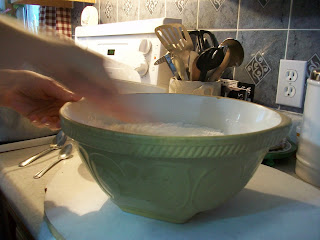
Once again, we incorporated both Auntie and Grammie into the experience. We used Grammie’s mixing bowl and Auntie’s cake pan (and recipe). And here is my Mom (with her big hands!) holding the cake just before we popped it into the oven.


The cake took 2.5 hours to cook, which seemed like forever. And because it is something we only make once a year, we were a little more observant than usual. We spent the majority of that waiting time in the kitchen. I worked on a craft project and Mom kept me company. At one point, Mom felt the cake was rising a little too much so she started talking to it with the hope that it would listen. Above, she pointed to the cake and told it to “STOP” as it still had 45 minutes to cook. Thankfully, it listened.


The cake turned out to be very level, which Mom said it sometimes difficult to achieve. She then gave me some hints as to how to get the cake out of the funnel pan. And flop, before we knew it, it was out.


I treasure these recipes – especially because they are written out by Auntie Hoolie and Mom. I treasure the well seasoned mixing bowl and cake pans once used by Grammie and Auntie. And I of course treasure the time and experience of baking with my Mom...and the laughs we have in the process.

Sunday, January 08, 2012

Meat Pie Anyone?

Every family has its Christmas traditions. Growing up, a typical Christmas Eve for our family began by attending Midnight Mass at St. Peter’s Bay RC Church. I recall singing in the choir with my friends and cousins, all of us struggling to get through the “G-l-o-r-i-a” stanza of “Angels We Have Heard on High” because (A) We were all so tired and (B) None of us knew how to get through the long stanzas properly. The church was always full as many families from nearby communities “came home” to the church they had grown up in for the Christmas celebration.

After Midnight mass, we all gathered next door to ring in Christmas Day with Auntie, Harold, Joe and Hilda. Sometimes it was just our immediate family and sometimes we were joined by cousins and neighbours. One thing that remained constant was Auntie’s meat pies. We all looked forward to this treat as this was the only time of the year she made them. Meat pies were therefore one part of the Christmas equation in our family.

Auntie’s meat pie recipe written out by Hilda.


Auntie and Hilda generally spent all day Christmas Eve making the pies. I was never involved in this baking and therefore didn’t pick up any of Auntie’s baking tricks of the trade. After Auntie’s death in 2003 this family tradition of having meat pie Christmas Eve lapsed for a few years. Circa 2008, my Mother expressed interest in possibly reviving the tradition. I recall my Father’s excitement; mainly because I had no idea he missed it so much. My Mother said she also loved the tradition (and the pies) so we decided to give it a go.

We dug up Auntie’s recipe and Mom talked with her nursing co-workers about their plan of attack with respect these pies – as many people make them. We were a little nervous about living up to Auntie’s high standard of cooking, but we decided to give it a shot. We made six or eight pies that first year and we were relieved to discover they were completely edible! One batch under our belts gave us the confidence we needed and we’ve done it every year since. Each year it seems to get easier and more familiar.

We’ve increased our productivity each year and this year produced fifteen pies - our largest number yet! We’ve made the process a little easier by involving the use of a food processor that greatly reduces the manual work involved (cutting all the meat!). In our pies, we use a combination of roast beef, pork and chicken, and we use Bertha MacAulay’s pastry recipe. Here’s a visual to this year’s Rossiter production line of meat pies:


The Pastry Master!

I still find the pastry difficult so Mom generally does this component of the process. Although she would never admit it, she’s a master of most items in the pastry field (her biscuits are second to none!). We also included Grammie in our annual tradition by using her bowl.


I somehow managed to forget to take a photo of the fifteen pies upon completion. But here is a shot of ten shells and four pies ready to go in the oven.


This year, I also decided to channel my inner Auntie by donning an apron, which I believe would have made her smile. You *never* saw Auntie without an apron. She wore one everyday (many of which she made herself) and she always had a clean one on hand in case unexpected company dropped by.


Although I forget to get a photo of the final fifteen, here is a close up of a completed pie to wet your appetite. I have two pies in my freezer here in TO and look forward to nibbling away at them well into the New Year.


And doing this with my Mother means of course we have a lot of laughs along the way. Some of the more memorable Mama Rossiter quotes from this year’s maratheon:

In reviewing the recipe prior to beginning my Mother said out loud “Bake at 400 degrees? That sounds kind of ferocious!”

Finishing the last pie she looked into the empty pastry bowl and said “I didn't think I would ever see it again (an empty bowl).”

After learning that her daughter-in-law Karen uses the left over juice that the meat was cooked in for gravy, Mom meant to say “And all the years I threw it out,” but instead said “And all the years I threw it up.”

I am already looking forward to doing it again next year.

Saturday, December 17, 2011

The White Kitten


Most weekends I talk to my Dad on the phone. The older he gets the more time he spends reminiscing about the past. This past weekend he re-told a story I’ve heard before but hearing it this time somehow caught my attention on another level. As he re-told the story, I could hear the excitement re-lived by his childhood self. It was touching to hear the impact one particular Christmas present had on him over sixty years ago.

By the time my Father was six years old he and his three siblings had left their childhood home in Morell and were being raised by their Aunt Hilda (Auntie) and Uncle Harold in Greenwich. His father had died when he was ten months old only to be followed by the tragic death of his mother six years later. To say this young family had a rough start would be an understatement, but they were fortunate in that Harold and Auntie kept the children together and raised them in a loving, structured home.

Christmas of 1944 was his first Christmas in Greenwich. My father, two months shy of his seventh birthday, remembers that winter well. One pastime the children had was watching their next door neighbour Walter Hayden from the east window in the kitchen. Everyday Mr. Hayden would walk to the back woods to see if he had caught anything in his traps and Dad said they would always watch him as he made his way back to his farm to see if he caught anything. Dad recalls that he was barely tall enough to see over the window ledge.

On Christmas day, 1944, Dad recalled that everyone sat in for dinner at the kitchen table and before long there was a knock at the door. Harold got up to answer the door and he heard Mr. Hayden at the door say “Is Bob there?” Dad said he nervously got up and went to door. When he got there Mr. Hayden reached into an inside pocket in his long black coat, pulled out a little white kitten, and said “Merry Christmas Bob.”

Dad recalled the excitement both he and his siblings expressed and remembered how difficult it was to then sit down to Christmas dinner. Ever since that Christmas, we have always had white cats on our farm – and if we don’t, Dad is in search of them. As I said, I’ve heard this story many times. But hearing it again recently I put it into context and saw, and felt it in a whole new light. I suddenly realized the impact that that the gift of this little white kitten would have on a child who at only six years of age had recently experienced such great tragedy in his life. I never knew Mr. Hayden but, but am touched by his gentle gesture. It is another reminder for me at this time of the year as to the true meaning of Christmas.


The Hayden Farm

Saturday, November 05, 2011

A glimpse of Ireland

A few collages of my trip to Ireland.


Many times man lives and dies
Between his two eternities,
That of race and that of soul,
And ancient Ireland knew it all.
Whether man die in his bed
Or the rifle knocks him dead,
A brief parting from those dear
Is the worst man has to fear.
Though grave-diggers' toil is long,
Sharp their spades, their muscles strong.
They but thrust their buried men
Back in the human mind again.

- William Butler Yeats
"Under Ben Bulben"

Saturday, September 17, 2011

Josie


It has been fourteen years since she died. I was in Japan when I got the call from Dad. That night I went to bed and dreamed about her. She was young, healthy, smiling, tanned and looked so beautiful. She looked so happy. The next morning I awoke and was shaken – the dream about her was so real. Maybe Dad’s telephone call had been the dream instead? I decided to call my Aunt Hilda that morning and as soon as I heard her voice I knew it had been real. Josie was gone.

Josie was the second youngest of five siblings in my Mother’s family. According to family reports Josie was spoiled from the get go. In her father’s eyes she could do no wrong, which of course sometimes frustrated the other children, including my Mom. While the older siblings were in school, Josie would get into their “stuff.” All the precious little items that at the time meant so much to them, such as make up samples betrothed onto them by their mother. Coming home to find Josie “made-up” with their makeup smeared all over her face resulted in an immediate kerfuffle. In later years Josie said to my Mother “I remember thinking that you hated me” and without skipping a beat my Mother replied “Because I often did” after which they broke into peels of laughter.

There are many others who know so many more of the details of Josie’s life than I. Time and time again, I’ve heard how incredibly popular Josie was and that always had “a million” friends. She was a beauty queen having been crowned “Queen of the Sea” while in high school, and she always had a boyfriend. She had it all. My childhood memories of Josie include images of many weekends she came to spend with us at the farm. My mother always looked forward to these visits. They would sit at the kitchen table and talk and smoke their brains out well into the night. It was the only time my Mother smoked, which I still find strange, but I believe they had a hell of a time. Looking back now, I realize that Mom and Josie were the most alike in their dispositions. They were both very secure in themselves, loved to laugh, have fun and enjoy life. They were both so real – nothing phoney at all – and that was what attracted people to them.


All of us in bed with Josie...when we were not supposed to be!

Josie married Jimbo, and we all thought the world of him. I remember bits and pieces of her wedding day. I remember Mom’s pink bridesmaid dress (which was later cut to a knee length dress that our cousin Maura wore to a prom dance) and how sweet Erica looked as her flower girl. I was in charge of throwing the confetti outside the church and was reminded on more than one occasion by Josie how I threw it in one big lump onto her head when she exited the church. All I remember is being nervous and letting it go, which in retrospect proved to be an early example of how I do not work well under pressure.

Josie and Jim bought a home on Queen Elizabeth Drive in Charlottetown and it was a home I would come to know well. After graduation, I moved into ‘town’ at ca. seventeen years of age and where I spent the subsequent two years. At that time, I shared a two bedroom apartment with three other girls and yes, it was hell. So during those two years, it wouldn’t be a stretch to say I spent the majority of my time at Josie’s house when I wasn’t at school or working. I had started my undergraduate studies at the local University and I worked at Cows on evenings and weekends. I often had to work late shifts and instead of taking a cab home, Josie often offered to come and get me. I can still see her waiting in the car for me on Queen’s Street. We’d go back to her place and would sit up watching late night TV, and I always stayed for the night. We had so many great chats and of course a lot of laughs. She was so easy to be with and she made me feel so loved. I am so grateful for those memories and for that time in my life.

At a very young age Josie was diagnosed with Chron’s Disease and it was a bad case from the outset. She had countless surgeries numerous periods of remission. When Josie was well, the world was hers. But when she was sick, she was naturally like a different person. The large doses of prednisone she took over the years resulted in her bones becoming very brittle very quickly. A number of effects and side effects from Chron’s Disease ultimately took their toll and Josie died in September of 1997. She left us much sooner than she should have, but we knew she was in a much better place. Her final days in this world were incredibly difficult and painful for her.

This time every September, I inevitably think of Josie. I think of her beautiful brown sparkling eyes and her laughter. I think of her manicured nails that often held a cigarette in place. I think of her and my mother sitting at our kitchen table in Greenwich talking and laughing. I think of all the good times and positive things, and am not sad because I truly believe she is in a better place. And I know she is still talking, laughing and making friends easily.

Friday, September 02, 2011

Dark Side of the Sun

I’ve always loved history. Looking back, I now realize I’ve always had a preference for social history. I avoided military history at all costs in University and remember being annoyed at the ‘guns and boats’ history students (mostly boys) who felt nothing else mattered in the grand scheme of things.

My grandfather Eugene Francis Rossiter served in WWI. It wasn’t until his war medals surfaced ca. ten years ago did I experience my first flicker of interest in military history. Once it became a personal story I could relate to, I saw military history in a completely different light. I placed an order for his Attestation Papers from Library and Archives Canada (that are now available online) and it provided me with more information than I had ever previously known about him.


His regimental number was 713255 and he enlisted on May 30th, 1916, when he was nineteen years old. My Grandfather served in the 105th Battalion along with many other Island men during WWI and he saw battle in France. Because my grandfather died when my father was only ten months old, we know very little about him. I was therefore grateful for every little piece of information gleaned from these papers – including the fact that like me he had “grey” eyes.


For Christmas, my brother Peter gave me the book Dark Side of the Sun by Michael Palmer. The book is about the author’s grandfather George Palmer and the Canadian Prisoners of War (POWs) in Hong Kong, and subsequently in the Omine Camp in Kyushu, Japan. It just so happens that George Palmer is from my hometown, St. Peters Bay. So again, this is story concerning military history is one that I had a connection to.

I babysat for George’s son Norbert and his daughter Joan – seven of his grandchildren in total. And a lot of those evenings where spent in his old home – the Palmer homestead in Cable Head. Before George passed away in 1991, my Mother (a nurse) did private duty with him in Souris hospital. I remember babysitting for Norbert and Mary the weekend of George’s wake and funeral. As I read this book I thought of all these connections but realized I knew nothing of George himself.

I had always heard that George would seldom talk of his war time experiences. I knew that he had been a POW in Japan and that was about it. I remember telling his daughter Joan that I was going to Japan to teach English. She responded be counting to ten in Japanese. I asked her how she knew to do that and she said her father George had taught her (he had learned from the Japanese guards who counted the POWS several times daily). It was these accounts and memories of George’s children that Michael Palmer relied on and incorporated into the book to trace George’s military service during WWII. With his children’s memories, personal letters written by George during the war and a myriad of primary and secondary sources, Michael weaved together his grandfather’s story and it was a fascinating read.

I learned a lot reading this book. For instance, the Geneva Convention (1929) marked the first time in history the treatment of military prisoners was governed – on paper. Unfortunately for the Allied Forces, including George Palmer, who surrendered in Hong Kong on Christmas Day in 1941, Japan ignored the provisions of the Geneva Convention, as did the Soviet Union and Germany.

Descriptions of the initial Japanese POW camps in Hong Kong were shockingly bad. The lack of food, quality of food, dysentery, no running water or electricity, no medical supplies, blankets, the mice, bed bugs, mice and rat infested conditions. It was shocking to read so I can’t even begin to imagine the reality of it all. The POWs were transported to Japan and arrived in Kyushu on January 22, 1943. The Allied Prisoners of war imprisoned in Omine Camp were ‘employed’ by the Farakawa Mining Company, from January 1943 until Japan’s surrender in August of 1945. Having changed its name several times his company is still in existence and is now called the Furukawa Equipment and Metals.

The camps in Japan were not as bad as in Hong Kong, but conditions were still dire. There was never enough food. George weighed 165 pounds upon enlistment and went down to 99 pounds by 1945, having lost approximately 40% of his body weight. As the war progressed, food shortages also took their toll on the Japanese homeland. It wasn’t only the POWs who suffered. Food was scarce for civilians too. Japanese army personnel often did not get much better food than their prisoners. Red Cross parcels were a godsend for prisoners, but were rare, and often did not make it to the POWs in the Omine Camp. The Japanese camp commanders camp them for themselves in case of invasion.

My great-uncle Pius Steele was also a Japanese POW in WWII. I was always told growing up that he knew George Palmer because they had met in a POW camp. This book dispelled that story as the book provides a list of Canadian POWs in the Omine Camp and does not include Pius’ name. I am now left to question if Pius was in other POW camps near Tokyo?

One quote from the book struck me: “George just happened to survive.” I am not sure if it was that simple. Surviving the conditions George faced as a POW took a special kind of emotional, mental and physical strength. Growing up, I always heard George Palmer described as a hero in our community. After reading this book, I now understand why. This book has also left me wanting to know more of my Grandfather’s military story.